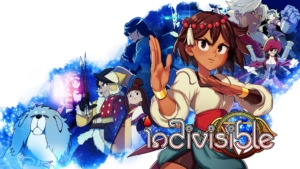
Indivisible is a curious mix of RPG and Metroidvania that boasts great art direction, but is marred by some questionable design choices that take the fun out of combat and exploration.Indivisible
Our Rating:
Meh
Indivisible is a curious mix of RPG and Metroidvania that boasts great art direction, building a colorful and vibrant fantasy world, but is unfortunately marred by some questionable design choices that take the fun out of combat and exploration.
The story follows Ajna’s quest to avenge her father, who was murdered in front of her by a soldier named Dhar. The problem is that, when Ajna – who is just 16 years old – tries to fight Dhar, she ends up absorbing him instead, and now must live with her father’s killer talking ceaselessly inside her head. With the help of some friends – who she absorbs as well, try not to judge her – Ajna travels to Mount Sumeru to fight the vile warlord Ravannavar, who intends to destroy the world because that’s in his job description.
Even though the villains are bland and one-dimensional, destroying everything because of a shallow nihilistic worldview, Indivisible’s story succeeds due to its critical approach to its protagonist. Ajna is the type of person who punches first and asks questions later: she is usually happy to solve problems with her fists and is quick to help people because that usually means she’ll have the chance to kick some butts.
At first, the narrative frames this behavior with a comical lens: we are supposed to laugh at her willingness to resort to violence, especially because her companions keep trying and failing to calm her down – including Dhar, who she understandably ignores. So, Ajna keeps doing her own thing, going to different places to punch the hell out of whoever is causing problems there, without ever trying to understand the nuances of their problems or to sort things out with, you know, conversation. It doesn’t take long, then, for her companions to realize that Ajna is saving the world for selfish reasons, that she’s doing it to appease her own anger and guilt, and for the tone to get more serious in return.
The fact that Ajna is doing it all for herself and not for others means that she doesn’t really care about the places she visits and the people she helps, which can lead to disastrous consequences. In one telling scene, she doesn’t allow one of her companions to leave the group to assist a town because she would miss them: Ajna’s top priority is not the world, but herself.
The problems regarding her behavior are at the heart of the story, which unfortunately doesn’t have many other discussions or themes. It’s a bit ironic that a narrative that criticizes a character’s self-centered personality makes the whole world revolve around that same character: Ajna is the savior, the chosen one, and a central part of the blight that affects the world.
This is a pity because she has more than twenty companions, but most of them have one-note personalities, without any semblance of a character arc. Take Razmi, for example, who will keep making the same sort of jokes about her I-like-to-watch-things-burn personality until the credits roll. And take Kushi, who is fond of animals and… that’s it. There’s another character who’s a white man – a righteous douchebag, of course – with the same job as Kushi, but with the added perk that he’s a righteous douchebag.
The only two side characters that display any semblance of a real, layered personality are Dhar and a healer named Thorani. Dhar’s arc is initially a fairly predictable one: by being forced to travel with Ajna, he has to face how his binary worldview – as is the case with most binary worldviews – is used by others to manipulate him into thinking and doing horrible things. He’s often treated as a pariah by Ajna, but manages to grow as a character by nonetheless showing himself to be more sensitive to the plight of others than Ajna herself – although, truth be told, that’s not exactly a high bar.
Meanwhile, Thorani is a bit eccentric – healing people by spurting them with water that comes out of her hair kind of eccentric – but gets some prominence as her caring nature turns her into a mother figure to Ajna, and her gentle disposition is often juxtaposed with the girl’s tendency to violence.
Some well-written sidequests would have gone a long way towards fleshing out Indivisible’s colorful cast of side characters, but they are too few and far between. Most even appear too late, offer little to no narrative payoff, and also require a lot of back and forth between places with no fast travel options.
The lack of fast travel is a recurring nuisance in the game, since the process of traveling from one region to another requires us to backtrack to the main town’s port, go to our ship, travel to the other town’s port, and then finally proceed to wherever we wanted or needed to go – and then backtrack to the port and repeat the whole process again each time. Shortcuts would have greatly alleviated the issue, but they’re as rare as excellent Assassin’s Creed games. So, if you are a vampire like Pierre, the purist, that doesn’t really matter, but to people with a limited time on this Earth, it can be frustrating.
Another problem regarding exploration is that the rewards are all the same and – to add insult to injury – are pretty useless as well. Indivisible is structured like your typical 2D Metroidvania (which makes the previous criticism even more relevant), with new abilities being regularly acquired to serve as “keys” to access rooms or areas that were until that moment out of our reach. In a Metroid game, these abilities come in the form of new equipment that we find hidden in the world or guarded by powerful bosses, while the rewards are small expansions to our arsenal or to our health. But in Indivisible, these abilities are taught to Ajna by her companions, and the rewards are all some red crystals that increase her defense or attack stat – and only after gathering a lot of them.
First, let’s tackle why having Ajna’s companions teaching her abilities tied to exploration is a problem. Kate, the kind, as you can expect, is a very forgiving person, but even she couldn’t believe it when a character taught Ajna the ability required to get into some locked rooms they had come across before. Why? Well, it’s because that character was on Ajna’s party at that time and they simply didn’t bother teaching it to her then, which led Kate to backtrack to the main town’s port, go to Ajna’s ship, travel to the other town’s port, and you get the picture.
In other words, a character won’t teach Ajna an ability if we organically, through exploration, come across a situation where it is required. No, this kind of thing only happens during scripted events in Indivisible, which can get nonsensical when progress in the main story is blocked in the same way: eventually, we reach a point in a neon-soaked Chinatown-inspired city, for example, where we can’t proceed because of some electrified platforms. So Thorani tells Ajna to go somewhere else for the time being. After we get to another town and explore it for a bit, Thorani herself finally teaches Ajna the ability that nullifies those platforms. Kate may be kind, but as you’ve probably already learned in life, kindness has a limit.
The second issue is that having only red crystals as rewards means that we’ll always know what lies inside a blocked room or at the end of a platform challenge: there’s no mystery or surprise involved in exploration anymore. You know when you sometimes think “oh, what’s behind that door?” Well, here the answer is red crystals. “What lies after that complicated gauntlet of obstacles?” Red crystals, my man. “What awaits us at the end of all things, when we ascend together to the heavens?” Yes, more red crystals. I’m sorry to break it to you, it’s just red crystals all the way.
A single red crystal doesn’t do anything at all by itself either – 25 of them are required to increase Ajna’s attack stat for the second time, for example – so getting a single one doesn’t give us a tangible reward for the trouble we went through. Even getting ten of them doesn’t mean anything. And to add even more insult to a very serious injury, when we finally get all twenty-five, the increase in our attack power is not that significant either.
In other words, exploration is highly discouraged in Indivisible, which also treats these red crystals as simple busywork: we’ll never find a whole new area on our own through exploration, or something as exciting. There’s just another red crystal tucked away in some room, offering virtually no incentive to explore.
Platforming is also very important in Indivisible, but there are also some problems with it. One of the most useful abilities in the game is to stick Ajna’s axe to a wall, allowing her to jump again. Theoretically, we only need to jump and press the attack button to activate this ability, but since the same button is also tied to a spear attack – it comes down to how hard we press it – Ajna may sometimes use her spear instead of the axe, leading us to miss the platform and usually fall to our death or several platforms below: the level design favors verticality, which often means that missing a jump will make us have to get past some old obstacles again to get back to where we were. Since the axe is such an important ability, the choice to have another type of attack tied to the same button is mindboggling, adding an unnecessary source of frustration. Bear in mind that Bob, the cynic, would say this is simply a skill issue, but that’s exactly why I don’t invite him to my birthday parties anymore.
Moreover, some hazards straight up kill Ajna while others just do some damage to her – and there’s no way of knowing which one is which beforehand. And the checkpoint system is everything but reliable: sometimes, dying will get us back to the last time we saved in a shrine – losing all our progress –, but sometimes it will get us back to the beginning of the room where we died. Sometimes, it will even get us back to the last time it autosaved our progress, ignoring the fact that we manually saved in a shrine afterward – which is either hilarious or infuriating, depending on whether you’re more like Kate or Bob. In other words, when we die, anything can happen, and we just have to roll with it.
The score, by Hiroki Kikuta (Secret of Mana), on the other hand, is stellar, with several memorable melodies, such as Criminal Alley and Promised Land, that give each region a distinct and fun personality. The game also nails its hand-drawn art, with bright colors and vibrant backgrounds: cities are a sight to behold, brimming with all sorts of exotic people that could easily have been playable characters or important NPCs in any other game due to the quality of their designs. And some of them even have some surprising lines, too: “When painting, striving for perfection just tires you out. Next thing you know, you’re in a slump. I make myself stop and relax, and eventually, I know I’ll get the will to paint again. After all, ain’t no right way to make art, only options. Er, I mean… um… Woof,” a dog says to Ajna.
Finally, we have the turn-based combat, which is fairly good, if still plagued with some issues. Encountering an enemy transitions Ajna to a separate battle screen, where three other members of her ever-increasing party appear to battle alongside her. Each of them is tied to a button and has up to four rechargeable attacks to use, which can change when coupled with an “up” or “down” input. The point is to make them all attack at once, building a combo meter that strengthens their blows.
Characters each have their role or playstyle: Dhar, for example, can charge his attacks, while Thorani heals the party with puddles of water (that come out of her hair), and Razmi inflicts slow on enemies and deals magic damage. They all have distinct speed stats as well, with Razmi taking a good while to recharge her attacks, while Dhar is quickly back into action.
The main issue with the combat is the repetitive enemy design. Except for armored enemies, which require one party member to use a down attack followed by an up attack to break their armor, they’re all basically the same enemy in practice: just hitting them with the most powerful attacks does the trick. Some rare ones are immune to magic damage, but none are immune to physical damage, so players won’t have to think too much during fights, even boss battles, and just choose the strongest move available.
Indivisible certainly nails its presentation, with a charming look and a catchy soundtrack by Hiroki Kikuta. Its narrative, though, could have done more with its impressive cast of characters, and some design choices make its Metroidvania aspect a real chore. Your mileage, of course, as with all things in life except Rise of Skywalker, may vary: Kate, for example, forgave the game’s shortcomings and quite liked the experience. I, on the other hand…
July 08, 2026.
Review originally published on February 05, 2021.
- Developer
- Director
- Writer
- Composer
- Average Length
- Available on