Having kids, if Pragmata is anything to go by, is really rough at all.Pragmata
Our Rating:
Good
“You got kids? Sounds rough.” Hugh Williams asks his colleague Nicholas No Last Name, who promptly replies, “Nah. I wouldn’t trade it for a thing.” Parenthood is at the core of Pragmata, a game that boasts an innovative and engaging combat system, but a narrative so sparse, shallow, and repetitive that it makes us long for the next moment our characters will stop talking and go back to being surrounded by bloodthirsty robots.
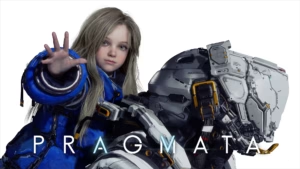
Hugh is a tech engineer who goes to the Cradle, an enormous station on the moon, to see why communication has been cut off. His team thinks it’s probably just an error, but nothing is ever that simple in space, so when a quake hits the Cradle and the station’s security – made of humanoid bots – starts cutting them down, they pay for their mistake with their lives. Hugh survives only by happenstance, as he’s found by D-I-03367, an android – a Pragmata, sorry – shaped as a little girl.

“It’s like I always say, you can never trust a bot,” Hugh says to his colleagues right when they arrive at the Cradle, condemning the station’s extensive use of robots and AI in all fields, from security to mining operations. But when he meets D-I-03367, he’s immediately captivated. He calls her Diana, treats her like a real kid, and just one mission later is already acting like her surrogate dad. Apparently, Hugh doesn’t trust bots only if they look like bots; if they look like people, they’re perfectly and immediately acceptable.
Hugh takes just three seconds to trust Diana and never, not once, holds her mechanical nature against her: it doesn’t matter for him that she doesn’t bleed, that her veins are wires, that her personality has been programmed to be like that, possibly emulating a real-life girl, or that she thinks in ones and zeros. For Hugh, Diana’s adorable and that’s all that matters.
That’s an idea Pragmata’s narrative takes to heart, as there’s nothing more to its story besides that. Each time we come across a checkpoint in a level, we can return to the main hub, a shelter where we can upgrade our gear, do training missions, and, more importantly, interact with Diana: we get to watch her play with toys, interact with the shelter’s facilities, and talk about recent events or general subjects. Diana reacts with childlike wonder to most things, has a playful attitude, and shows a genuine interest in what Earth is like: she’s always keen to hear Hugh talk about it and he’s always happy to indulge her. She’ll throw a basketball at him, knocking him down, and Hugh will be like “That’s great, kiddo!” Sometimes, she’ll hand him a drawing of both of them together and awkwardly phrase something that reads as “I love you.”

In other words, their interactions are heart-warming and touching, but they’re just that. The fact that she’s not a real girl is glossed over as quickly as crimes perpetrated by right-wing governments, and talking about real kids, Pinocchio has much to teach Diana in terms of acting like one: he’s annoying and mischievous, he complains a lot, he goes his own way, and he disobeys. What Geppetto wouldn’t have given to have made someone as adorable, lovable, and compliant as Diana, who acts like an idolized version of a child: all cuteness; no bother – she doesn’t even get insufferable over her original name ending with a 67, if you can believe that.
If parenthood is one of the main themes of Pragmata, its discussion on the subject has as many layers as Diana and Hugh’s relationship, meaning it doesn’t have any. Of course you wouldn’t trade it for a thing, Nicholas; having a kid apparently doesn’t have any downside. Hugh only has to make sure she stays alive and, even so, Diana’s metal skeleton is much more reliable than the bones of a regular kid, so even if a security bot kicks her across the room, she’ll be alright in a jiffy.
And besides their relationship, what else is there to the story of Pragmata? Nothing much, as it turns out. There are barely any cutscenes – or characters – in the game, with the antagonist being severely underutilized (Diana yearns for a conversation with them, but the game never gets them more than 20 seconds of dialogue together) and the dialogue itself can sometimes be nonsensical. There’s a moment near the end (I promise I’ll be as vague as humanly possible) where Hugh asks Diana’s opinion on a subject. She gives it and asks Hugh if she’s right, and he answers that if she believes that’s how it is, then that’s how it is. Sounds cute and supportive, right? Except the antagonist also has an opinion on the same subject matter, and it just happens to be the complete opposite of Diana’s. Are they right as well because that’s how they believe it is? Well, the game never goes into that: Pragmata’s narrative is afraid of questioning anyone or anything, ending up with the same vibes as the files and emails we can find scattered around the station: drab and lifeless.
The Blue Fairy only brings Pragmata to life when it puts us in the middle of a firefight, as it mixes the action of a third-person shooter with the problem-solving aspect of a puzzle game to great effect: if Hugh just shoots at enemies, he’ll do negligible damage to them, barely scratching their metal. No, before Hugh fires his gun, Diana must first hack the enemy bots to expose their weak points – and we do that by guiding a cursor in a grid square, passing by specific nodes (if we are using a controller, we shoot and dodge using the triggers while moving the cursor with the face buttons) until we reach the goal marked in green.

We must solve this puzzle in real-time, which means we have to dodge enemy fire while hacking enemies, moving the cursor in the grid to the right spots while positioning ourselves better on the field. Since we usually can only hack one enemy at a time, we must also choose whether to finish off a hacked enemy before they go back to normal or hack another to leave both of them vulnerable to, let’s say, a shotgun blast. In sum, this system is not only novel but adds pressure and decision-making to each second of each fight.
As we progress, more nodes appear on the grid as well, and while some are beneficial, adding effects to our hack (burning enemies, decreasing their defense, or spreading the hack to others), others slow down, block, or reset our progress. Boss fights, in particular, have many of those nasty nodes to reinforce the spike in difficulty (their often humongous size, homing missiles, and building-leveling lasers are not enough for that, of course).
Besides that, we can equip a plethora of mods – passive perks – that change our basic stats, making us stronger in some areas but weaker in others. The idea is to encourage players to create builds specialized in certain actions, be it long-ranged combat, for example, or hacking. But the benefits they give us are too tame to really make a difference, and the synergy between the mods is not always there: there are a couple of effective combinations between the more than thirty available mods, but that’s it. It’s the same with the upgrade points: Pragmata is that type of game where we can spend a bunch of them to deal 0.2 more damage to enemies. Yeah, I know you can’t wait to deal 0.2 more damage to enemies. You’ve been waiting all your life for this moment.

So, luckily, Pragmata’s level design is quite good at incentivizing exploration: much like Mario games, it places “coins” in places of interest, so that we have a reason to go there and suddenly spot a hidden chest nearby or a secret room. Levels are usually full of branching paths, hard-to-spot corners, fake walls that reveal hidden items, and sometimes even chests locked by powerups that we’ll get later on, forcing us to return to a level to collect everything – which is a bit of unnecessary padding, let’s be honest here.
Most of the items we find in chests or hidden behind walls are meant to enhance Hugh and Diana’s combat prowess (making us deal that glorious 0.2 increase in damage), so the best ones – the ones we really get excited when we discover – are the holographic renditions of toys, such as cars or balloons, or common objects, such as a fireplace or a camping tent, that we can place in the main hub and watch Diana be adorable as she interacts with them.
Although the game takes place entirely in a space station, each one of the six levels – which are quite long, taking more than an hour each – has a distinct theme. In the Cradle, they were experimenting with a substance that allowed them to 3D print all sorts of objects, so when Hugh ventures toward the Coms Tower, for example, instead of the station’s usual cramped white corridors, we find the expansive streets and tall buildings of New York City, with the streets being broken apart and the buildings looking half-finished, distorted: the effect is uncanny. Another level has us moving in zero gravity while a metallic version of the great Shai-Hulud hunts us down any time we step on the sand: each level has not only its own visual motif, but also a distinct mechanic or set-piece.

Pragmata, then, has a great combat system and a striking art direction that are let down by a bland, almost contradictory story that focuses too much on a kid being adorable to care about anything else. Having kids, if Pragmata is anything to go by, is really not rough at all.
July 13, 2026.
- Developer
- Director
- Writer
- Composer
- Average Length
- Available on