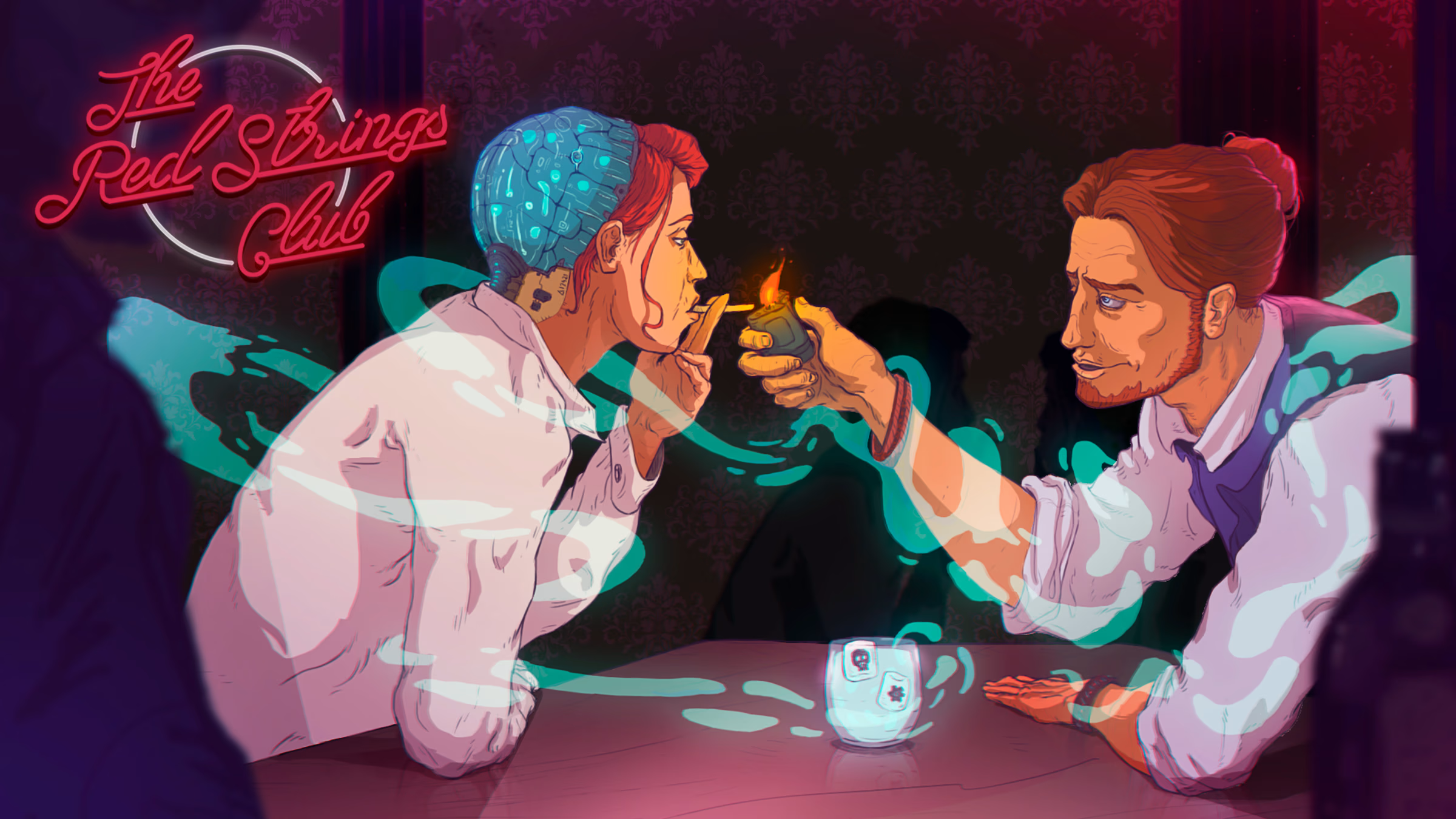
Despite some structural problems, The Red Strings Club is a great game that takes full advantage of its cyberpunk setting to raise important questions about agency in an increasingly cybernetic world.The Red Strings Club
Our Rating:
Great
The Red Strings Club is a cyberpunk bartender game in which you pour special drinks to get information out of people. And although it largely succeeds in developing its discussions on free will, power, and (the lack of) agency, its all-over-the-place structure hampers some parts of the experience.
We mainly play as Donovan, the bartender of The Red Strings Club, who is an information broker on the side. Donovan can “use spirits to tune into customers’ emotions,” to allow them “to savour, mourn, or contemplate their souls’ fundamental sentiments.” In practice, this means each customer has some circles around them displaying certain states of mind, such as anxiety, regret, and pride. Each spirit we pour into the glass, in turn, veers a “soul disk” into a specific direction (absinthe makes the disk go left, while tequila makes it go down), and so the objective is to make a drink that moves the disk to match the circle (in other words, the emotion) we want to activate.
After serving the drink, the customer will react to it, and the conversation will be influenced by the emotion we triggered. Serving our friend Brandeis a glass of pride, for instance, makes him open up about his plans to hack the North District traffic mainframe and earn bitcoins. Now, serving him a glass of regret will make him confess he’s sorry to be working for the same rebel group that tortured Donovan, making us aware of the bartender’s stance on the “hacktivist” group Proxima: they may be dangerous and violent, but they nonetheless remain the only ones that can “play on a level field with the corps and the government.” This means we get different info based on what we serve our customers – and, since the game often autosaves after each decision, we will be stuck with that information, stimulating repeated playthroughs to learn more about these people and their world.
Donovan lives in a futuristic city dominated by corporations, not much unlike ours. Here, androids make implants that tap into people’s minds: if a guy is having trouble amassing followers in his social media accounts, he can go and get an implant that will increase his “online social network charisma.” There are enhancements that “block negative stimuli” and even eliminate “the need for social acceptance.” In other words, if Donovan can manipulate people’s emotions with his drinks, corporations can mold their entire personality.
The plot starts when one of these androids – Akara-184 – breaks into the bar, almost destroyed, and pleads for help. After accessing its memory data, Donovan discovers a corporate plan to release an implant that is supposed to eliminate depression, sadness, and anger. While some people think this implant is good – who doesn’t want to be happy all the time? –, Donovan knows capitalism very well, and so begins his investigation into the true intentions of the Supercontinent Ltd.: will these implants make people docile and more prone to exploitation? Anger, after all, gets shit done. Will they be optional or mandated? Are they already inside everyone and just need to be activated?
As Supercontinent’s employees enter his bar, Donovan gets a chance to know more. Diana Meyes, the leader of the project, for example, seems to be pure in her intentions, thinking her implants will “serve the greater good.” Another employee, Larissa Robillard, thinks only in terms of what she will gain with the project: “Darling, I’m all right with selling weapons, not getting shot by them,” she says to Donovan.
The story mostly revolves around the illusion of agency. Dononan makes his clients reveal information with his drinks, pulling their strings – as the name of his bar suggests – but he has a problem when corporations start to do the same thing. People are being fully manipulated here: their feelings and, consequently, their ideas are tailor-made fabrications. This is shown literally with the implants that Akara makes for Supercontinent’s clients: in this sequence, we must carefully mold some clay to match a specific design – set, of course, by the corporation – to attend the needs of a client.
The implant Donovan is trying to stop from being marketed, like his drinks, taps heavily into people’s emotions, and it is said it can even stop rape, murder, prejudice, and fear responses. His position, therefore, as other characters are not shy to point out, is a hypocritical one: Donovan doesn’t have a problem with people being manipulated… if he’s the one doing it. But the implant itself also raises interesting questions: we would all love it if horrible crimes stopped altogether (at least, I hope), but the things we are willing to sacrifice to make that happen… well, therein lies the rub.
Supercontinent employees openly talk about how marketing is completely based on manipulating people; how tapping into people’s emotions is what politics is all about; how people everywhere are being constantly bombarded with information and opinions, with images, sounds, and colors: basically, how we never stood a chance. Supercontinent’s big implant is just the conclusion of this process. It even sheds a light on the problem of modern democracy: do the people still have political power if they have become puppetized, unwillingly letting others choose their representatives for them?
And the situation quickly grows more complex, as this is a cyberpunk world where powerful AIs exist. Akara, for example, can read people perfectly and even make ethical decisions. Donovan used to pull the strings in his club, but when Akara starts to work for him, he immediately stops being the smartest one in the room. The game’s climax, then, is a pessimistic one, showing that the battle is not to cut the strings, but for the puppet master position.
The writing is far from subtle, however, using its noir vibe to make the character reflect openly on the sad state of their society. Right at the beginning, for example, Brandei states: “We live in a city ruled by corporations. If I didn’t associate with scoundrels I’d be out of work in no time.” But there are some quirky elements in the narrative to balance the tone. Donovan, for example, has a supernatural aura around him: his connection with the club is shrouded in mystery, which is further reinforced by the end of an excellent encounter with an optional customer and a dangerous game of Russian Roulette.
At the end of each interrogation, Akara also quizzes Donovan about the last customer to test if the bartender – and so the player – really got how that character truly ticked, giving rewards if the most answers are right – although never revealing which we got right and which we didn’t.
The game’s narrative structure, however, is a bit problematic. After a brief tutorial that shows how preparing drinks works, instead of starting to develop that mechanic, the game shifts to Akara’s perspective, and we must learn how to mold clay into specific designs. The best thing would have been to put Akara’s part as a prologue, before everything, and then focus only on the bartender part – and make that prologue skippable in subsequent playthroughs, as it’s time-consuming. The climax also abandons the bartender setting and becomes a basic point-and-click adventure, making the conclusion feel out of place regarding its mechanics.
So, despite some structural problems, The Red Strings Club is a great game that takes full advantage of its cyberpunk setting to raise important questions about agency in an increasingly cybernetic world.
May 20, 2026.
- Developer
- Director
- Writer
- Composer
- Average Length
- Available on