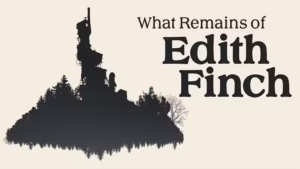
What Remains of Edith Finch is a complex game both in terms of thematic discussion and presentationWhat Remains of Edith Finch
Our Rating:
Excellent
One of the main distinguishable elements of the Gothic genre is the spectral presence of the past, which returns to haunt the characters and remind them of the things they want to forget – and usually the more we live, the more we want to forget. The setting in What Remains of Edith Finch is a house built on memories, which hide the key to understanding the curse that plagues the Finch family: the game’s gothic narrative is enveloped by a fatalistic atmosphere marked by grief and loss, with stories that are impactful not only due to their unique presentation but also because of how inevitable their tragic outcomes seem to be.
We control the young Edith Finch in the first-person, seeing the words of her diary hover over the environments. When her mother dies, Edith discovers that she has inherited a mysterious key, so, being the last descendant of the Finch family, she now feels compelled to return to her childhood home and dig up the family history.
The Finch house is a character of its own. From afar, centered in a marshy landscape, it seems twisted, with strange addendums forming a crooked tower that barely seems to be holding itself in place. Its interior, on the other hand, is ostentatious but – long abandoned – still reflects the decadence of the Finch family, which, contrary to genre tropes, is not aristocratic, but bourgeois: we are not dealing with a crumbling medieval castle of an old lord or prince, but with a mansion built by successful businessmen.
The design of the house reflects this thematic change, then, being defined by a typical capitalist trait: accumulation. Its several rooms and floors are crammed with piles of books, photographs, tickets, and diaries that, taking up a good part of the space, give the house a claustrophobic feeling despite its enormous size. Edith’s family home doesn’t feel cozy, but oppressive.
It’s a true Gothic mansion, in other words, labyrinthine and full of secret passages, hiding a mysterious past. It’s no wonder, then, that Edith herself notes how her ancestral home still instills fear in her: the house is a gloomy and oppressive place. And its logic of accumulation extends beyond the mess inside, too, for the new Finch generations were not placed in the old empty rooms of their ascendants, but in new rooms built exclusively for them. This means that the house had to grow with each passing generation, in an unsustainable manner, looking now as if ready to crumble down at any moment under all that hoarded weight.
The words of Edith’s diary assume important roles in the game, appearing in the middle of the house’s innumerable objects – sometimes glued to the walls, sometimes floating above some suspicious article: the words serve as a form of narration, contextualizing those objects by explaining their history, but also function as a guide for the player, pointing at what is important and interactable in each room. While exploring the house, which contains plenty of surprises and eccentricities, Edith delves deep into the memories of her family, reliving their last moments alive.
Death is the main antagonist in What Remains of Edith Finch and the obsession of its many characters. As Edith points out during one scene, the first thing built on her family’s land was a cemetery: death is at the beginning and end of the Finch family’s history. They all considered it a curse of some kind, to the point of some of them even getting to monsterfy the concept, framing death as a living creature lurking in the shadows. That logic of accumulation behind the twisted form of the house, then, is a form of protest: it’s a way of denying death the complete obliteration of its victims, making the whole house a symbol of resistance, growing with each passing generation in an attempt to refuse to forget those who came before. Loss, after all, is an unimaginable concept for the bourgeois.
It’s just fitting, then, that the main action in the game is the act of reliving memories, momentarily resurrecting each member of the Finch family while we read their diaries, letters, and confessions. In these scenes, we leave Edith behind and start to control the character from the memory in question, reliving their last moments alive. These stories assume a paradoxical role, representing a small victory over death – a brief resurrection in the form of memory – at the same time that reminds us that death is truly inescapable.
In these sequences, after all, death is the unwanted goal. We know that it’s what awaits each one of these characters at the end, so each of our actions – each time we decide to move or speak or pick up an object– is imbued with tension because it’s putting them one step closer to the moment of their death. We are guiding them toward their demise and we can’t change a thing about it: it’s a memory, the past, so their terrible fate is already set in stone. Death is the unavoidable endpoint of each story.
And each one of them has a unique structure, aesthetic, and mood, for they mirror their character’s specific mindsets, showing us their fears and desires, but also immersing us in their particular imagination. When we’re controlling little Molly, for example, we follow her as she travels around the house, transforming into several animals in search of something to satisfy her hunger: we’re witnessing her playful and wild demeanor being reflected in the dark fairy-tale framing of her last moments alive.
In the game’s standout moment, we embody a young man frustrated with his job at a canning factory. We can sense that he has the sensibility of an artist, whose creativity is being shackled by the methodical nature of his work, when the screen gets divided in half, with one part displaying he working at the factory, slicing the fish, while the other reveals his boundless imagination – for the young man is imagining himself as a hero while he works, a caped crusader setting out on a grand adventure in a fantastical land.
Our controller is then put to mirror this duality: we’re required to perform the mechanical act of slicing the fish while directing the hero’s journey, managing both realities at the same time with each half of the controller. The first half manages a straightforward activity, since we just press a button to slice fish as they appear on the screen: it’s a simple, mechanical, mindless action. The second half, on the other hand, stimulates the mind, as it’s much more about context: there are choices to be made, characters to meet, and even a great art direction to analyze.
Soon, this adventure section even begins to gain more prominence on the screen, taking more and more space from the work in the canning factory, mirroring the character’s growing disconnection from reality while making the task of slicing the fish increasingly more difficult – and so more dangerous to the young man.
The attention to detail during this section is the icing on the cake. The intrusion of fish imagery in several parts of the fantastical scenery, such as a relief on the walls of a palace, for example, works as an uncomfortable reminder of the character’s dull reality. Meanwhile, the absence of a face on the people who appear sympathetic to the young hero’s journey reinforces our character’s loneliness: even his cat shows up to congratulate him in a certain scene, but his own family is never there for him.
Another sequence, which leads to the death of a young actress, is also a remarkable moment. It assumes a comic book aesthetic with the structure of a slasher, but it’s actually more about the comedy underlying the horror, with the humor arousing from the unexpected sadism of the narrator: he builds up to the moment when the girl will scream in horror and die, but then proceeds to subvert our expectations by constantly delaying this climactic moment with increasingly preposterous context.
The prose in What Remains of Edith Finch also deserves special mention, for it reveals surprising details about each one of Finch’s family members. Little Molly, for instance, especially considering her age, is given a sinister quality with her comments that display hints of cruelty (“I imagined his face looking up and seeing mine through my talons,” she happily comments after grabbing an animal to eat) while the jubilation she feels when killing animals that are also mothers (“A momma rabbit!” she exclaims while hunting one) is both concerning and thematically appropriate, as the story’s main conflict revolves around a dispute between two mother figures: Edith’s mother and grandmother.
The grandmother, called Eddie, with her superstitions and fantastic notions, is the great architect of the myth surrounding the house. At times, she’s shown to be almost cruel in her fight against “the curse of death”: she forces one boy to continue to live in the same room he shared with his brother after the latter’s untimely death, for example, giving him a rope to separate his side of the room from the deceased’s, which possibly made the event even more traumatic for the boy, as the rope functioned as a constant reminder of the tragedy and how death separated them forever.
Edith’s mother, on the other hand, rejects this ghastly aspect of the family but still ends up contributing to it anyway, for while Eddie unwillingly builds the haunting atmosphere of the house, reinforcing the impact death has on the family, Edith’s mother runs away from the place, denying its influence on her: while one mother turns death into a monster, the other refuses to talk about it. The game’s climax, then, works precisely because it focuses on this clash of approaches and ideas, ending with an interesting thematic subversion, as it presents life and death at the same time.
What Remains of Edith Finch is a complex game both in terms of thematic discussion and presentation, leveraging them to tell a brilliant Gothic story about our eternal struggle with death.
May 31, 2026.
Review originally published in Portuguese on June 22, 2018.
- Developer
- Director
- Writer
- Composer
- Average Length
- Available on