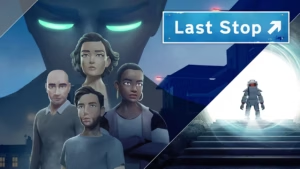
Despite its weak conclusion, Last Stop still entertains.Last Stop
Our Rating:
Good
Last Stop presents three different stories set in the same city, mixing family drama with the fantastical: they are mostly well-told tales, featuring endearing characters and some neat ideas, even though they take too long to converge into a proper climax, which consequently feels rushed and underdeveloped.
There are three main characters in Last Stop. We have John Smith, a middle-aged white man stuck with a terrible desk job, who finds solace in caring for his daughter, Molly. One day, his neighbor, Jack, bumps into a strange man in the subway and is cursed alongside John, who was there just trying to defuse the situation. So, when they both wake up the next day, they have switched bodies with each other. Then, there’s the laconic Meena Hughes, who works for a private military agency: she’s a cold, pragmatic agent who seems to care much more about her job than her family. Finally, we have the young Donna Adeleka, who has a crush on her best friend, Vivek, who happens to be a paranoid teen who is spying on their mysterious neighbor – Vivek claims that the strange man brings people into his house, but they never come out.
The stories vary a bit in tone. John Smith’s veers more into comedy, playing with its “body-swap” premise, while Meena’s chapters are more suspenseful and tense, reflecting her job and personality, and Donna is basically caught in an adventure. We can choose which character to play as first (we control their movement, select some answers now and again, and play one or two shallow minigames), but after their chapter ends, we have to choose one of the other two, which means we can’t stick with one character for the whole duration of their story: Last Stop wants us to keep switching between them.
Their first chapters are all about presenting their routines and establishing their personality. When John Smith goes to work, we get a “Press A to hit the keyboard” prompt, but when we do it, John just hits each key one at a time, very slowly, exuding frustration. We’ve all been there, mate; we feel you. The printer, of course, doesn’t work either – the detestable bastards – and when he calls the help center, he’s put on hold… indefinitely. His boss is a selfish prick, that kind of man who likes to harass his coworkers to show his power, but with a “playful” attitude to mask the crime.
The game doesn’t delve too much into this theme, however. Actually, quick cuts from one setback to the next build a comedic tone, as we never see John solving any of them, but just moving from one problem to the next as they pile up. The point of his first chapter is to show that nothing seems to work for poor John, as even his mail is delivered to another guy—his neighbor Jack. In a nice touch, this suggests that their identities were already being mixed up before the body swap occurred.
Moving to Meena Hughes provides a stark contrast. Her story begins with two agents asking her questions like, “Would you kill a loved one if your job mandated it?” and the fact that she doesn’t answer with “no” or “never” is already a great look at what drives her. But just like with John’s time at the office, there’s a bit of playfulness at how the game presents the character to us: to show that she’s a cold and calculating woman, but also a quite sharp one, the screen suddenly freezes when she meets a new recruit and we have to move the cursor – the command is “Scan for weaknesses” – to see how Meena evaluates the woman based on her outfit, her facial expression, on how she folds her arms, and other details like that. It’s a funny scene because it’s all about Meena’s paranoia: she has just met this new recruit, and the command reveals how she’s already in a state of alert, assuming the woman is dangerous.
Meena is also full of herself, so we are meant to take her conclusion as the truth even though we can see she’s ultimately choosing to ignore some of the warning signs she noted herself: she may think, “Surprised at her clearance level,” after looking at the recruit’s badge, but still dismiss the woman as nothing to be worried about, “Full Name: Amy Ng. Not a name I plan to remember.”
Later, when she’s texting her father, we can see from where she took the commanding personality she exhibits even during a sex scene. For, while John Smith and Donna have the fantastical as the propelling element of their story – the body swap and the mysterious stranger –, Meena’s core concern is just family drama. For example, she cares for her father but needs to maintain a cold, almost detached interaction with him because he’s often too harsh to her, almost hostile at times, constantly passing judgment on her actions and decisions.
The thing about these troubled family relationships is how people are always ready to lash out at each other: each comment made is rife with a passive-aggressive attitude that was built by years of troubled interactions with each other. Every piece of advice is actually a reprimand in disguise because family members are tired of having to say the same things over and over again to one another. Consequently, each minute of spending time together feels more like an annoying obligation than a genuine desire. Meena’s life seems to be collapsing under the weight of this problem: she’s becoming too detached and bitter and is barely enjoying life anymore – that sex scene is revealing because we understand she’s doing it more for escapism and chemical relief than anything else.
Donna’s first scene also shows how she feels controlled by her family, especially her sister, who chastises her for not doing her homework, goes looking for her when she’s with her friends, and who’s literally a cop. When the girl leaves her house and a song starts to play while she goes to hang out with her friends, we can feel the freedom: she’s running, the music is energetic and fun, and Donna is smiling.
One of her friends is Vivek, who’s a bit paranoid and a big believer in conspiracy theories (they even joke about the time he was a flat-earther, which he’s ashamed of, good for him). He believes the government has a secret database of their prints and files, and that the handsome black man across the street is a communist organizing a guerrilla movement in secret, since he’s always bringing girls to his house but they never leave. Donna and their other friend, Becky, joke about Vivek missing the obvious – but still quite tense – explanation.
Bored, they decide to follow the man, who goes for a swim and suddenly glows green. They panic, of course, and Becky hits the guy on the head: the following chapters are about their attempts to interrogate this man, who they tie up to a chair and keep locked up in an abandoned building for days. Just like anyone would do if they found out the neighbor is actually green.
Donna’s story, then, suffers from some issues. First, these three kids basically kidnap this man because of things they can’t prove, and they’re keeping him locked up for days, without trying too hard to interrogate him or realizing the gravity of the situation they’re in. They treat this thing like it’s akin to skipping a day of school – something that should stay a secret because it will have consequences if grown-ups ever find out – and not as a serious crime that is endangering their lives and even that man’s life, since they never seem to bother to give him food and water.
Donna also doesn’t find it too odd that the man only speaks to her, remaining completely silent when others are around, and she even goes along with some of his most outlandish suggestions, in the vein of “Could I, the man who glows green and probably kills women, stretch my legs for a moment and go for a walk alongside you, my kidnapper, in this abandoned building, with the friendliest of intentions?” This creates a disconnection between us and the character, with Donna acting like those teenagers in horror movies who seem to lack common sense – or basic survival instinct, really.
Since they all live in the same city, it’s only natural that these characters would pass by each other eventually – the game even suggests this connection by putting them sitting next to each other on the subway on the character selection screen. However, their stories only converge in the last chapter, which is an odd decision, as it’s precisely in this chapter where the supernatural finally takes center stage. This means that the narrative doesn’t leave the fantastic much room to breathe: despite all the build-up to it, there’s little to no worldbuilding regarding the odd locale the game suddenly introduces at the last minute, leaving its reveal anticlimactic and the magical elements that surround it as just that: random magic.
This is a pity, because the narrative had been quite good until this point. Much of John’s chapters are your usual body-swap story, with comedy arising from the characters having to pretend to be someone else, but his story still has some interesting moments on its sleeve: it’s fascinating, for example, to see how both Jack and John feel free to contest injustice in their workplace now that they’re not accustomed to it. John gets mad at the suggestion of crunch (Jack is a game developer), for example, while Jack doesn’t stand for his new boss’ inappropriate behavior. There’s also a tension regarding John’s health and how Jack’s actions in his body may revoke John’s guardianship over Molly, which raises the stakes.
Meanwhile, Meena’s story gets progressively intense, as she starts to suspect everyone around her while her sense of superiority is put into question. And Donna’s relationship with her sister constantly shifts, as it often happens with family: at one moment, her sister may be an antagonist, a threat to her freedom, but at the next, she’s the person Donna wants to go for help.
But it’s all moving towards the final chapter, where all the strange things become the focus. Here, however, things fall apart, as the events don’t add much to the characters and fail to bring resolution to some important arcs. John’s story, for example, doesn’t need this fantastical setting, as it adds nothing to his plight. Meena, meanwhile, just becomes an action hero, with the events focusing more on her boss than Meena herself. And Donna’s story suffers from the lack of resolution regarding that strange green man. He seems to think Donna’s special in some way, but the reason for that is never explained or hinted at: his motivation remains unclear, his powers seem arbitrary, changing or evolving over time following no discernible logic, and the more he acts, the more incomprehensible he gets.
But, despite its weak conclusion, Last Stop still entertains. Its stories are playfully told, exploring the characters’ troubled relationships with their respective families. However, its fantastical elements are not fully developed, which makes everything regarding them lose its power.
June 03, 2026.
- Developer
- Director
- Writer
- Composer
- Average Length
- Available on